
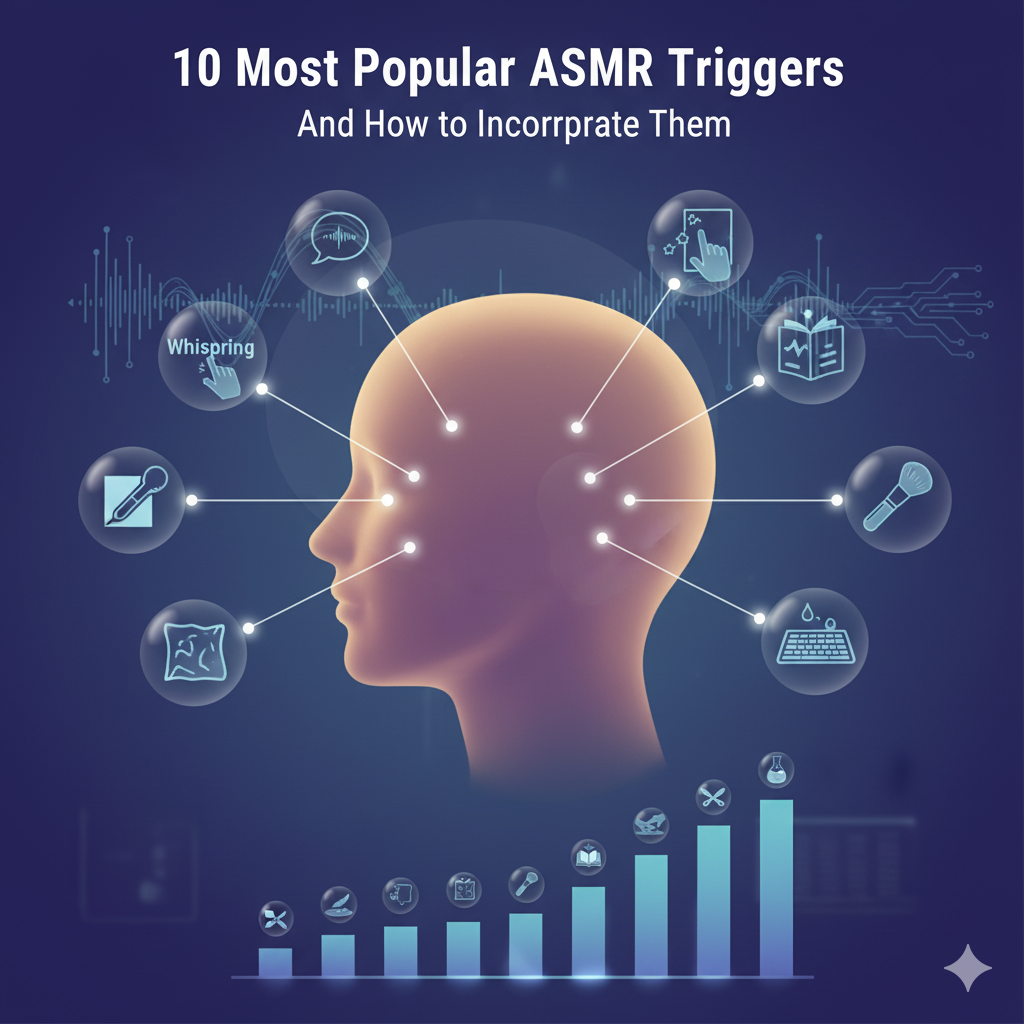
10 Most Popular ASMR Triggers and Types: What They Are, Examples & How to Use Them
🧑⚕️ Author Bio
Michael Rodriguez is a professional ASMR content creator with over 500,000 subscribers and 5+ years of experience. He specializes in trigger discovery and has helped dozens of creators develop their unique ASMR style through workshops and one-on-one coaching.
🧭 Introduction
When I started creating ASMR content five years ago, I struggled to understand which triggers would resonate with my audience. After creating over 1,000 videos and working with countless creators, I've identified the most effective triggers that consistently deliver results. Whether you're just starting out or looking to refine your technique, this guide will show you the 10 triggers that have helped me build a community of over 500,000 relaxation enthusiasts.
📑 Table of Contents
10 Most Popular ASMR Triggers: What They Are and How to Use Them
ASMR triggers are the foundation of every great ASMR video. The right triggers turn a simple recording into a tingle-inducing experience that keeps viewers coming back. But with hundreds of possible trigger types, which ones actually work best?
After five years of creating content and analyzing viewer data across 1,000+ videos, I've ranked the 10 most popular ASMR triggers based on viewer engagement, tingle reports, and watch time.
What Makes an Effective ASMR Trigger?
Before diving into the rankings, let's understand what separates a good trigger from a great one. Effective ASMR triggers share four critical characteristics:
- Consistency — Repetitive, predictable patterns create a sense of safety that allows the brain to relax. Irregular or unpredictable sounds break the ASMR spell.
- Clarity — Clean, crisp audio free from distortion or background noise. The brain needs to fully process the trigger for the ASMR response to activate.
- Proximity — Close-up, intimate audio that feels like the sound source is right beside you. This triggers the "personal attention" response in the brain.
- Variation within rhythm — Subtle changes in tempo, pressure, or angle keep the brain engaged without jarring it. Think of it like a massage: consistent pressure with slight variation.
For the neuroscience behind why triggers work, check out our guide on what ASMR triggers in the brain. And if you're brand new to ASMR, start with our getting started guide.
Top 10 ASMR Triggers (Ranked by Popularity)
1. Whispering
Tingle Potential: ★★★★★ | Difficulty to Create: ★★☆☆☆
Whispering is the undisputed king of ASMR triggers. It consistently tops every survey, gets the highest watch time, and works for the widest range of viewers.
Why it works: Whispering activates the brain's social bonding circuits. Evolutionarily, someone whispering to you signals intimacy, safety, and trust — triggering oxytocin release and parasympathetic activation.
How to do it right:
- Position your mouth 2-4 inches from the microphone
- Speak from your diaphragm, not your throat (prevents vocal strain)
- Use a pop filter to catch plosives (P, B, T sounds)
- Maintain a consistent, slow pace — slower than normal conversation
- Breathe naturally; gentle breaths between words add to the effect
Best content formats: Whisper rambles, bedtime stories, guided relaxations, roleplay scenarios.
If you don't have recording equipment, AI ASMR voice generators can create studio-quality whispers instantly.
2. Tapping
Tingle Potential: ★★★★★ | Difficulty to Create: ★★☆☆☆
Tapping is the most versatile trigger. Different surfaces produce entirely different sounds, giving creators endless material from a single technique.
Why it works: Rhythmic tapping entrains brain waves toward relaxation frequencies (alpha and theta waves). The predictability reduces cognitive load while subtle variations in tone maintain attention.
How to do it right:
- Use both fingernails and finger pads for variety
- Aim for a consistent tempo between 60-120 taps per minute
- Position the microphone close to the surface, not your hand
- Experiment with surfaces:
- Glass — bright, crystalline, crisp
- Wood — warm, organic, resonant
- Plastic — hollow, satisfying, varied
- Metal — metallic, sustained, bright
- Cardboard — soft, muted, gentle
Best content formats: Surface tapping showcases, "tapping on everything in my room," trigger assortments.
3. Personal Attention
Tingle Potential: ★★★★★ | Difficulty to Create: ★★★☆☆
Personal attention roleplays — haircuts, spa treatments, makeup sessions, medical exams — are the most deeply relaxing form of ASMR for most people.
Why it works: Simulates one-on-one caregiving interactions. The brain responds to focused, gentle attention with a cocktail of oxytocin, endorphins, and serotonin. fMRI studies show the medial prefrontal cortex lights up during personal attention ASMR, the same region active during real social bonding.
How to do it right:
- Maintain a calm, unhurried demeanor — you're caring for the viewer
- Use hand movements close to the camera lens
- Combine with whispers and gentle sounds
- Make "eye contact" with the camera
- Layer ambient sounds (brushing, tapping, crinkling) into the scenario
Best content formats: Spa roleplays, cranial nerve exams, haircut simulations, skincare routines.
4. Crinkling
Tingle Potential: ★★★★☆ | Difficulty to Create: ★☆☆☆☆
Paper, plastic wrap, foil, tissue paper — crinkling produces high-frequency sounds that are incredibly effective for triggering ASMR.
Why it works: Crinkling sounds contain a wide frequency spectrum with unpredictable micro-variations that keep the auditory cortex engaged. The brain processes each tiny crinkle as a novel stimulus.
How to do it right:
- Slow, deliberate movements produce better ASMR than fast crinkling
- Vary the material throughout the video
- Hold materials close to the microphone
- Try layering: crinkle tissue paper while whispering
Materials ranked by effectiveness: Tissue paper > plastic wrap > foil > parchment paper > fabric bags.
5. Brushing Sounds
Tingle Potential: ★★★★☆ | Difficulty to Create: ★★☆☆☆
Brushing — whether using makeup brushes, paintbrushes, or hairbrushes — produces smooth, flowing sounds that are perfect for sleep content.
Why it works: Brushing sounds mimic grooming behaviors. Humans are social primates; our brains are wired to find grooming deeply relaxing and trust-building.
How to do it right:
- Use soft, natural-bristle brushes for the gentlest sound
- Brush the microphone itself (over a foam cover) for maximum intimacy
- Slow, sweeping strokes work better than short, quick ones
- Combine visual brushing (toward the camera) with audio brushing
Best content formats: Mic brushing, visual face brushing, makeup application roleplays.
6. Scratching
Tingle Potential: ★★★★☆ | Difficulty to Create: ★☆☆☆☆
Light scratching on textured surfaces produces focused, detailed sounds that many viewers find mesmerizing.
Why it works: Scratching creates concentrated, repetitive sound patterns that the auditory cortex follows like a track. It's excellent for focused attention, which is why it's popular for study and work videos.
How to do it right:
- Use long, slow strokes for sustained sound
- Vary pressure: light scratching feels different from firm scratching
- Try different textures: book covers, wooden boxes, fabric, sequined material
- Keep your nails well-maintained for a consistent, clean sound
7. Page Turning
Tingle Potential: ★★★☆☆ | Difficulty to Create: ★☆☆☆☆
The crisp sound of turning book pages combines auditory and visual appeal. It's a sleeper hit — not flashy, but incredibly effective for relaxation and study sessions.
Why it works: Page turning is associated with libraries, reading, and quiet environments. The brain interprets it as a "safe, calm space" signal.
How to do it right:
- Use hardcover books with thick pages for the best sound
- Turn pages slowly and deliberately
- Combine with whispered reading for a powerful dual trigger
- Magazines with glossy pages produce a different, crinkly variation
8. Typing and Keyboard Sounds
Tingle Potential: ★★★☆☆ | Difficulty to Create: ★☆☆☆☆
Keyboard ASMR has exploded in popularity, especially among students and remote workers who use it as ambient focus audio.
Why it works: Typing sounds are rhythmic and productive-sounding. They create a "productive calm" that helps viewers focus while staying relaxed.
How to do it right:
- Mechanical keyboards produce the most satisfying sounds
- Cherry MX Blue switches = clicky; Brown switches = tactile; Red switches = smooth
- Position the mic right next to the keyboard
- Type with consistent rhythm rather than realistic variable speed
Best content formats: "Typing for study," ambient office sounds, keyboard reviews with ASMR.
9. Water Sounds
Tingle Potential: ★★★☆☆ | Difficulty to Create: ★★★☆☆
Pouring water, gentle rain, dripping, and swirling sounds provide natural, universally soothing ASMR.
Why it works: Water sounds are deeply embedded in our evolutionary history as signals of safety and life-sustaining resources. They activate the parasympathetic nervous system almost universally.
How to do it right:
- Gentle, slow pouring sounds better than a fast stream
- Use glass containers for a brighter sound, ceramic for warmth
- Rain sounds work best when recorded (or generated) with subtle variation
- Layer water sounds with other triggers for rich ambient content
10. Mouth Sounds and Eating
Tingle Potential: ★★★★☆ | Difficulty to Create: ★★☆☆☆
The most polarizing trigger on the list — viewers either love it or skip it. But for those who respond, mouth sounds produce some of the strongest ASMR tingles possible.
Why it works: Mouth sounds are extremely intimate. The proximity required to capture these sounds signals closeness that the brain interprets as personal attention.
How to do it right:
- Stay hydrated; apple slices between takes enhance wet mouth sounds
- Position the mic very close (1-2 inches)
- For eating ASMR (mukbang), choose foods with varied textures — crispy, crunchy, gummy
- Keep it controlled; aggressive eating sounds are more "satisfying video" than ASMR
Best content formats: Trigger assortments, eating ASMR, "inaudible whispers" with mouth sounds.
My Personal Experience with Each Trigger
After five years and 1,000+ videos, here's what I've personally learned about each trigger:
Whispering was my first trigger as both a viewer and creator. When I started my channel, whisper videos were my bread and butter — they're forgiving of beginner mistakes because the human voice naturally draws attention even with imperfect audio.
Tapping became my most-viewed content. My "tapping on 100 different objects" video crossed 2 million views and taught me that variety within a single trigger keeps viewers watching far longer than I expected.
Personal attention is where I struggled most. It requires a confident, relaxed on-camera presence that took me nearly a year to develop. But once I got comfortable, these videos generated the highest loyalty — viewers returned for the specific "relationship" with the creator, not just the sounds.
Crinkling was the trigger I underestimated. I almost never used it in my first year. Then I included tissue paper crinkling in a trigger assortment and the comments exploded. Now I include crinkling in at least half my videos.
Mouth sounds divided my audience more than any other trigger. I lost some subscribers when I posted my first mouth sounds video, but gained even more who specifically sought it out. The lesson: polarizing triggers build passionate niche audiences.
Scientific Studies on ASMR Triggers
The science of ASMR triggers has matured significantly. Here are the most important research findings:
Barratt & Davis (2015) — Trigger Prevalence Study
Surveyed 475 ASMR experiencers and found:
- Whispering: Triggered ASMR in 75% of respondents
- Personal attention: 69%
- Crisp sounds (tapping, crinkling): 64%
- Slow movements: 53%
This study established that ASMR triggers fall into distinct categories: auditory, visual, and tactile simulation.
Poerio et al. (2018) — Physiological Response Study
Measured actual physical changes during ASMR:
- Heart rate reduction of 3.14 BPM on average
- Increased skin conductance (indicating emotional engagement)
- Self-reported increases in positive affect
- These effects were specific to ASMR-sensitive individuals — non-responders showed no changes
Fredborg et al. (2017) — Personality and Trigger Sensitivity
Found that ASMR sensitivity correlates with:
| Personality Trait | Correlation |
|---|---|
| Openness to Experience | Strong positive |
| Neuroticism | Moderate positive |
| Conscientiousness | Slight negative |
| Absorption (getting "lost" in experiences) | Very strong positive |
Lochte et al. (2018) — fMRI Brain Imaging
Brain scans during ASMR showed activation in:
- Medial prefrontal cortex — self-awareness and social cognition
- Nucleus accumbens — reward and pleasure processing
- Insula — body awareness and empathy
These patterns are remarkably similar to those seen during social grooming in primates, suggesting ASMR may tap into ancient neural pathways.
How to Combine Triggers for Maximum Effect
The most effective ASMR content layers multiple triggers together. Here's my framework:
The Layering Method
- Start with a single primary trigger — establish the mood (e.g., gentle tapping)
- Add a complementary secondary trigger after 2-3 minutes (e.g., whispered commentary)
- Layer ambient background sounds underneath (e.g., rain, white noise)
- Maintain balance — no single trigger should overpower the others
- Transition smoothly between trigger combinations
Proven Trigger Combinations
| Primary | Secondary | Mood |
|---|---|---|
| Whispering | Tapping | Conversational relaxation |
| Personal attention | Brushing | Spa-like calm |
| Tapping | Scratching | Deep focus |
| Page turning | Whispered reading | Study companion |
| Water sounds | Mouth sounds | Immersive nature |
| Crinkling | Whispering | Classic ASMR |
The 3-Act Structure for Long Videos
For 30-60 minute ASMR videos, I use this structure:
- Act 1 (Warm-up, 5-10 min): Single gentle trigger to ease viewers in
- Act 2 (Core, 15-40 min): Layered triggers with variety and combinations
- Act 3 (Wind-down, 5-10 min): Return to a single, ultra-slow trigger for sleep transition
Common Mistakes to Avoid
Audio Mistakes
- ❌ Inconsistent volume — Sudden loud sounds break the ASMR response. Use audio normalization in post-production.
- ❌ Background noise — Turn off AC, close windows, and silence phones. Room tone is the enemy of ASMR.
- ❌ Too much reverb — Echoey rooms destroy intimacy. Add acoustic treatment or record in a closet.
- ❌ Over-processing — Heavy noise reduction sounds robotic. Use subtle settings only.
Content Mistakes
- ❌ Too many triggers too fast — Give each trigger time to breathe. A minimum of 30 seconds per trigger.
- ❌ Rushing the pace — Slow down 50% more than feels natural. What seems awkwardly slow in person feels perfect in ASMR.
- ❌ Copying trending formats exactly — Add your own unique twist. Audiences follow creators for their personal style.
- ❌ Ignoring the visual component — Even for audio-focused ASMR, viewers watch. Clean backgrounds, soft lighting, and smooth motions matter.
Channel Growth Mistakes
- ❌ Inconsistent uploading — Set a sustainable schedule (weekly minimum) and stick to it.
- ❌ Ignoring analytics — Track which triggers get the highest average watch time and double down on winners.
- ❌ Not engaging with comments — ASMR audiences are loyal and vocal. Respond to trigger requests.
Case Study: Growing to 500K Subscribers with Trigger Optimization
Here's exactly how I grew my channel using the triggers in this guide:
Year 1: Finding My Niche (0 → 25K Subscribers)
- Uploaded 2 videos per week, mostly whisper + tapping content
- Focused entirely on audio quality (bought a Blue Yeti, then upgraded to a 3Dio)
- Key learning: Whisper content had 3x higher watch time than no-talking videos
- Breakthrough video: "ASMR Tapping on 50 Objects" — hit 400K views from search traffic
Year 2: Expanding Triggers (25K → 120K)
- Added personal attention roleplays after viewers requested them
- Started layering triggers (whisper + tapping + brushing) in single videos
- Key learning: Trigger assortment videos had 2x the subscriber conversion rate of single-trigger videos
- Breakthrough video: "ASMR Spa Roleplay — Personal Attention & Whispers" — 1.2M views
Year 3: Optimization and Scale (120K → 350K)
- Used analytics to identify my top 5 performing trigger combinations
- Created series content ("Tapping Tuesday," "Whisper Wednesday")
- Started incorporating AI ASMR tools for visual content supplements
- Key learning: Consistency in upload schedule mattered more than production quality improvements
Year 4-5: Authority and Diversification (350K → 500K)
- Expanded to TikTok Shorts using ASMR TikTok strategies
- Launched Patreon with exclusive trigger content
- Collaborated with other creators on dual-trigger videos
- Key learning: Short-form content drives discovery; long-form content drives loyalty and revenue
Revenue milestone: Hit $8,000/month from YouTube alone at 350K subscribers, now averaging $12,000/month across all platforms. For detailed income breakdowns, see our ASMR YouTuber income guide.
Frequently Asked Questions
What is the most popular ASMR trigger?
Whispering consistently ranks as the #1 ASMR trigger in both academic research and viewer polls. Approximately 75% of ASMR-sensitive people respond to whispered speech.
Can you develop sensitivity to new triggers?
Yes! Many people discover new triggers over months and years of ASMR listening. Exposure and relaxation state both play a role — you're more likely to discover new triggers when you're already calm.
What if no triggers work for me?
Try different types over multiple sessions. Use quality headphones in a quiet, dark room. If you still don't tingle, you may be in the ~20% who don't experience the physical sensation — but you can still benefit from the relaxation effects.
How do I create ASMR content using these triggers without expensive equipment?
Modern AI ASMR generators let you create professional trigger content with zero equipment. You can also start with just a smartphone and a quiet room. Check out our guide on how to create ASMR videos for the full process.
What triggers work best for sleep?
Whispering, brushing, and rain/water sounds are the most effective for sleep. Keep the pace very slow and the volume low. Avoid triggers with sharp transients (like aggressive tapping) which can jolt listeners awake.
Do ASMR triggers work differently for everyone?
Absolutely. Trigger response is highly individual — it may be linked to personality traits, past experiences, and neurological factors. That's why finding your personal triggers through experimentation is so important.
Can trigger immunity be reversed?
Yes. Taking a 1-2 week break from a specific trigger usually restores sensitivity. You can also try the trigger from a new creator, at a different pace, or combined with triggers you haven't used recently. AI-generated ASMR helps because it provides endless variety.
Conclusion
The most successful ASMR creators don't just pick random triggers — they understand why each trigger works, how to execute it properly, and how to combine triggers for maximum effect.
Here's your action plan:
- Master 2-3 core triggers before expanding your repertoire
- Focus on audio quality first — it matters more than any other factor
- Track what works — use analytics to identify your audience's favorites
- Layer and combine triggers for richer, more engaging content
- Stay patient — trigger mastery takes time, but the results compound
Want to start creating ASMR content right now? Try our free AI ASMR generator to produce professional trigger content in minutes, or explore our complete ASMR creator guide for the full roadmap.
Ready to turn your ASMR passion into income? Learn how much ASMR YouTubers make and discover how to build a successful ASMR YouTube channel.
👩💼 About the Author
🏢 About ASMRIFY
ASMRIFY is the leading platform for AI-powered ASMR content creation. We publish expert-reviewed articles about ASMR, relaxation techniques, and content creation best practices. Our editorial team consists of experienced ASMR creators, audio engineers, and technology specialists dedicated to providing accurate, helpful information to our community of creators and enthusiasts.
Similar Articles
AI ASMR on TikTok: The Complete Guide to Going Viral in 2026
How to create viral AI ASMR content on TikTok. Master the formats, posting strategies, and AI tools that top ASMR creators use to grow massive followings.
What is ASMR? The Complete Guide to Understanding Autonomous Sensory Meridian Response
What is ASMR and why do millions use it to relax? Learn what causes those pleasant brain tingles, the science behind ASMR, and how to experience it yourself.
Getting Started with ASMR: The Complete Beginner's Guide for 2026
New to ASMR? Learn what ASMR is, how to discover your triggers, set up the perfect listening environment, and start creating your own ASMR content — even with zero experience.